COOPENAE
Credit Card Application and Formalization System.

UX/UI

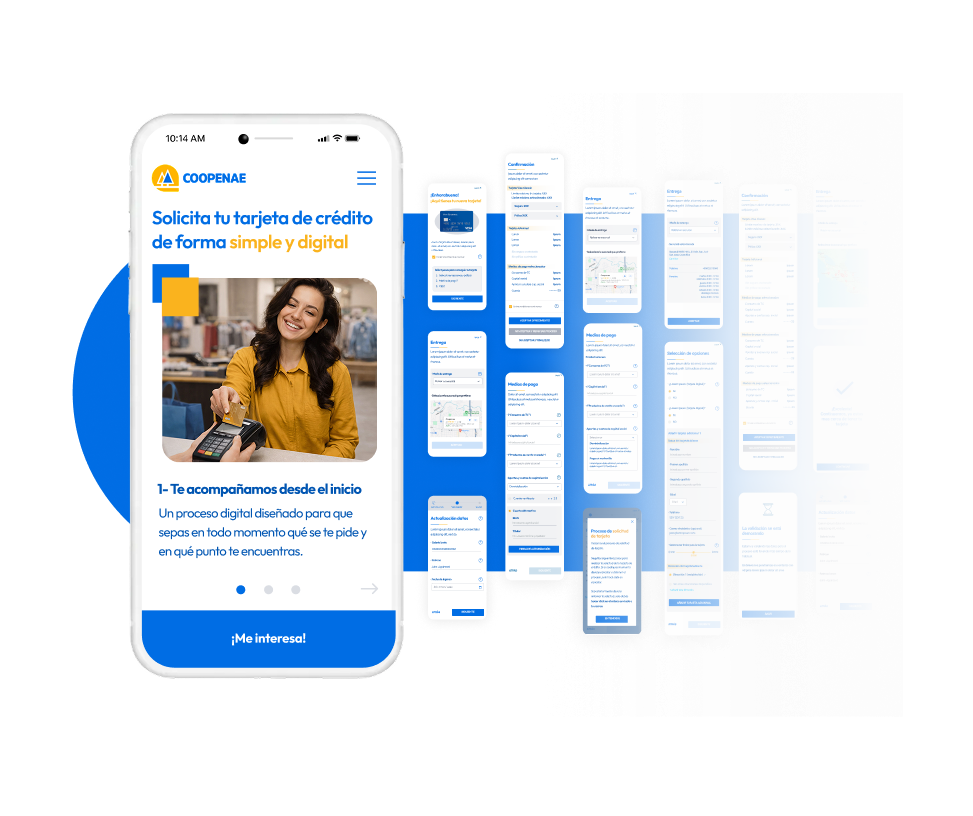
My role in the project
Design of the user experience (UX) and visual interface (UI). Definition of the information architecture and the system of stages and states. Design of the interaction model, content hierarchy, and navigation logic.
Coopenae, one of the leading financial cooperatives in Central America, needed to enable a digital credit card application and formalization process that would allow its members to autonomously manage a procedure traditionally characterized by length, fragmentation, and strict regulatory constraints.
The objective was not merely to digitize an existing process, but to make true end-to-end self-management viable, integrating regulatory validations, risk analysis, checks with external authorities, and legal formalization, without relying on in-person channels or transferring internal system complexity to the user.
This type of product introduces a clear tension: on one side, a financial system governed by multiple rules, exceptions, and control mechanisms; on the other, the need to provide a clear and continuous experience for non-expert users, who may start the process in different contexts, interrupt it, and resume it later without losing orientation or information.
The design challenge therefore lay in structuring an experience capable of absorbing that complexity and translating it into a state-driven flow, where each system decision had a clear correspondence in the interaction, and where both users and internal teams could operate with confidence, traceability, and control.
For confidentiality reasons, this project cannot display final screens or complete flows. The case therefore focuses on describing the design decisions, system architecture, and interaction logic that make a complex financial process operable in a digital context.
The challenge
For Coopenae, the challenge was not simply to offer a credit card, but to make an entire financial process operable in a digital environment, under a strict regulatory framework and with multiple internal and external dependencies.
Within a single flow, the credit card application had to resolve very different scenarios: pre-approved and non-pre-approved members, identity and biometric validations, checks with regulatory institutions, automated and manual risk analysis, document collection and verification, legal signing, and product formalization. All of this had to meet high standards of traceability, auditability, and operational control, inherent to the financial domain.
From an experience perspective, the risk was twofold. On one hand, building a rigid and fragile flow, unable to absorb exceptions, errors, or pauses without breaking the process. On the other, exposing users to internal system complexity, generating friction, abandonment, or dependency on in-person channels to complete the application.
The challenge, therefore, was to design a resilient experience capable of adapting to multiple states and branches, allowing interruptions and resumptions without loss of context, integrating automated decisions and manual validations without perceptible breaks, and maintaining a clear understanding of progress and next steps at all times.
The goal was not to simplify the financial system itself, but to structure it so it could be navigated with clarity, while preserving the reliability and control required by the cooperative.
Designing the experience
The solution was conceived from the outset as a stage- and state-based experience system. The objective was to allow a long, regulated, and non-linear process to progress, branch, pause, and resume without losing coherence or traceability, and without requiring users to understand the system’s internal logic.
The system was structured into clearly defined stages, each with specific responsibilities within the process: origination, application, pre-analysis, analysis, offering, formalization, delivery, and activation. This division responds not only to operational needs, but also to a logic of comprehension, introducing only the information, inputs, and decisions that are relevant at noted point in the journey.
Each stage functions as a container of states, and progression does not occur through simple linear steps, but based on specific conditions. The interface acts as a continuous guidance system, explaining what information is being requested, why it is required, and which validations are taking place. Inputs, messages, and descriptions are organized hierarchically, using grouping, nesting, and encapsulation to guide users step by step and reduce errors before they occur.
Visible steps, system states, and contextual messages constantly reinforce orientation and sense of progress, making explicit what has been completed, what is currently in progress, and what remains pending highlighting the path ahead. Primary actions are presented in a clear and predictable manner, while secondary or contextual information remains accessible without competing for attention, even in long forms or complex validation scenarios.
Because credit card applications are rarely completed in a single session, the system stores progress continuously and allows users to resume the process at the exact point where it was left, preserving context, validations, and prior decisions. This behavior avoids unnecessary restarts and reinforces a sense of control without introducing additional interaction complexity.
When automation is insufficient and the flow transitions to manual validation, the experience remains coherent through clearly defined states and explanatory messages that prevent opaque blocks or silent failures. The system maintains a clear understanding of what is happening and how the process will continue, even when human intervention is required.
This approach turns onboarding into a resilient system, where the interface does not merely present information, but structures interaction, organizes complexity, and supports users through successive decisions in a demanding financial environment.
The project results in a digital financial onboarding system capable of absorbing a long, regulated, and non-linear process without transferring that complexity to the end user. The design does not remove rules or validations, but organizes them into a progressive, recoverable, and understandable experience.
The system enables progression through clearly defined stages and states, manages branches and pauses naturally, and maintains a consistent understanding of progress and next steps. The coexistence of automation and manual validation strengthens user trust and reduces friction in a traditionally complex process.
Overall, the project lays the groundwork for a robust and scalable financial self-management experience, ready to evolve in functionality, channels, and usage volume, while maintaining operational clarity for both cooperative members and internal teams.